
Everything You Need to Know About the British FTSE 100 Index
Overview of the Index
The FTSE 100 Index is the most important stock market index in the United Kingdom.
It is a key benchmark for measuring the performance of major companies listed on the London Stock Exchange and is considered a reflection of the British economy.
The index includes the 100 largest companies in the UK, based on market capitalization and liquidity.
The index covers around 32 different sectors, with three sectors exceeding £200 billion in value: banking services, pharmaceuticals, and oil & natural gas. Together, these three sectors account for about 32% of the index’s total market capitalization.
The FTSE 100 was launched on January 3, 1984, and is managed by the FTSE Group.
Key Sectors in the Index
The FTSE 100 includes about 32 sectors, such as:
Energy
Telecommunications
Banking and Financial Services
Basic Materials and Mining
Consumer Goods
Mining and Extraction
Software and Computer Services
Major Companies in the Index
AstraZeneca
Shell
Standard Chartered
HSBC Holdings
RELX
Unilever
British American Tobacco
London Stock Exchange Group
GSK (GlaxoSmithKline)
Auto Trader Group
Barclays
Lloyds
Vodafone
BT
Diageo
AstraZeneca, Shell, Unilever, HSBC, and RELX together account for nearly 32% of the index’s total weight.
Trading Hours
On the London Stock Exchange:
Opening: 08:00 am
Closing: 16:30 pm
When trading the index via brokers and CFDs, it can be traded 24 hours a day from Monday to Friday.
Ways to Trade and Invest in the Index
1. Trading through brokers and Contracts for Difference (CFDs), such as Pepperstone, Exness, and Tickmill.
2. Futures contracts.
3. Exchange Traded Funds (ETFs), the most notable being the iShares Core FTSE 100 UCITS ETF.
4. Mutual funds.
5. Buying shares of companies listed in the index, such as AstraZeneca or HSBC.
Key Advantages of the Index
1. High liquidity, making it one of the world’s most important indices.
2. Represents the largest 100 companies in the UK, offering relatively safe investment opportunities.
3. Reflects the strength and performance of the British economy.
4. Wide sector diversification reduces the risk of over-reliance on a single industry.
5. Strong dividend payouts, especially in energy and banking sectors.
6. Long-term investment potential through ETFs.
7. Multiple trading methods available, including CFDs, ETFs, and mutual funds.
Disadvantages of Trading the Index
1. High concentration in certain companies such as AstraZeneca, HSBC, and Shell, which together account for over 15% of the index.
2. Sensitive to geopolitical events.
3. Strongly affected by Bank of England decisions and interest rate changes.
4. Influenced by global news, especially from the United States.
5. Weak representation of modern sectors such as technology, which is one of the least weighted in the FTSE 100.
6. Heavy reliance on multinational corporations, with around 70% of profits generated outside the UK.
7. Strong dependence on energy and metals sectors, meaning fluctuations in oil and commodity prices heavily impact the index.
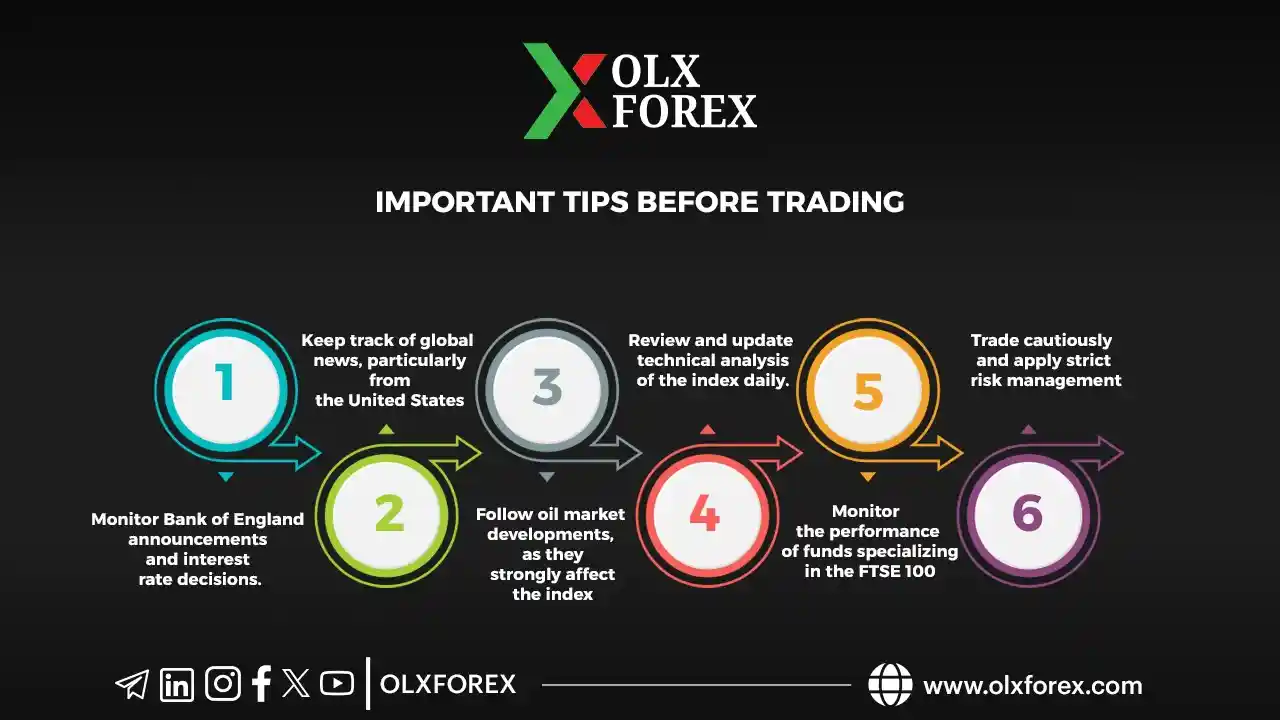
Important Tips Before Trading