
How to avoid margin calls in Forex trading
To trade in the Forex market, you need to have a thorough understanding of how margin and leverage work in order to avoid margin calls.
A margin call is one of the most feared situations for a forex trader because it means that your account no longer has enough margin to maintain your open trades, and therefore the broker may automatically close them to avoid further losses.
So what are the basics of margin, margin level, and leverage?
- Margin:
This is the minimum amount of capital required by the broker as collateral to open and maintain trades, and it acts as a protection for both the trader and the broker against potential losses.
- Margin Level:
This is the ratio between equity and used margin, calculated using the formula:
Margin Level = (Equity / Used Margin) × 100%.
If you reach a level below 100%, it means that your balance is no longer sufficient to cover losses, and a margin call is triggered.
- Leverage:
This means that the broker allows you to control a trading volume that is much larger than your actual capital.
Leverage itself does not cause a margin call, but rather its misuse does.
Effective strategies to avoid margin calls:
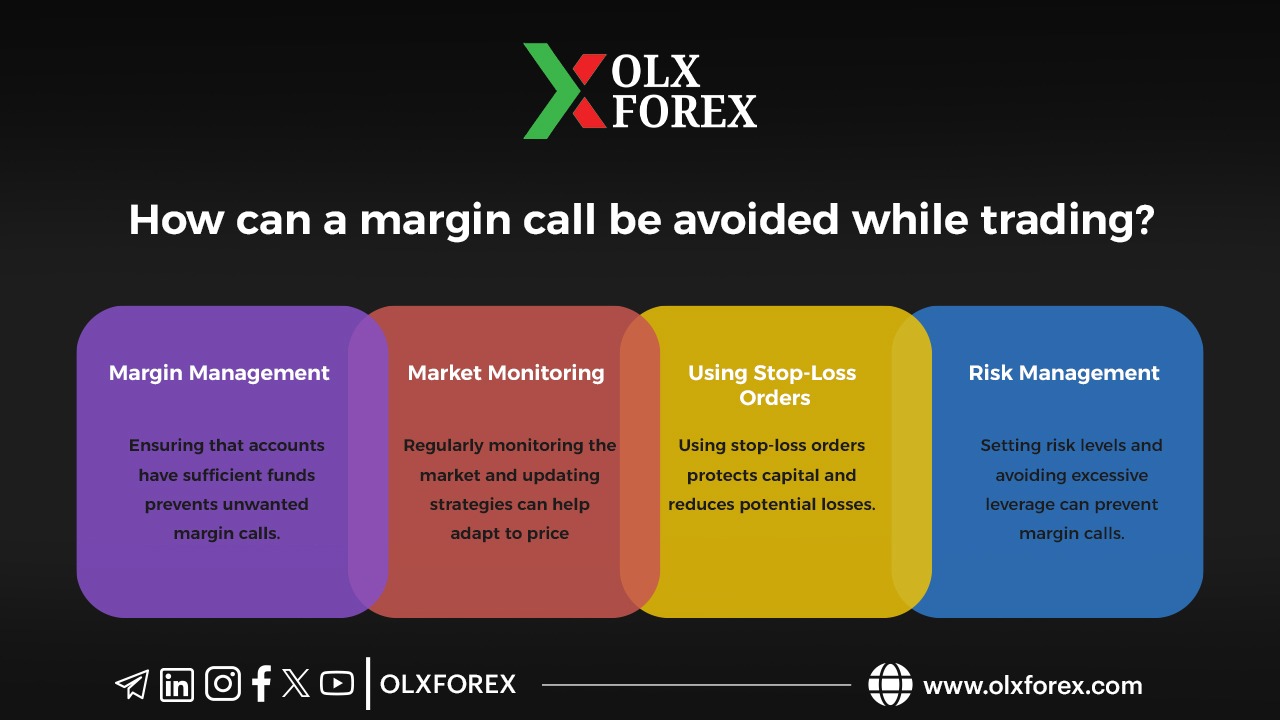
- Use leverage wisely and don't overdo it:
High leverage (such as 500:1) allows you to open large positions with little capital, but it also seriously multiplies your losses.
The advice, especially if you are a beginner, is to choose leverage that is appropriate for your strategy and experience (such as 50:1 or 100:1) rather than the maximum leverage available.
Remember that overuse of leverage is the main cause of margin calls.
- Determine the size of the position correctly and manage risk:
Do not risk more than 1-2% of your capital in a single trade, because risking more than 5% or more and with the first few losses may deplete your account.
- Use stop loss orders:
Set a clear exit point in advance for each trade to limit losses and protect your capital.
- Continuously monitor your margin level and free margin:
Maintain a high margin level (200% or more), as this gives you a safety buffer to absorb negative fluctuations without reaching the risk threshold.
Continuously monitor your free margin, which is the capital available to open new trades or cover losses, and make sure you always have sufficient free margin.
- Avoid excessive trading and focus on the quality of trades:
Do not open a large number of trades at once. Even if each trade has a low risk, their accumulation increases the total risk and exposes you to a margin call if the market moves against you.
You should also be aware of asset correlation: opening trades on highly correlated assets such as AUD/USD and NZD/USD increases your actual risk, as you could lose on all of them if the market moves in one direction, and they often move together.
- Avoid over-leveraging losing trades:
Leaving a losing trade open for too long increases margin consumption. It is better to stick to your plan and close the trade when it reaches your stop loss.
- Maintain a free margin buffer:
Do not invest all your capital in trading; always leave a cash reserve in your account to deal with unexpected movements.
- Use alert tools:
Set alerts to monitor your margin and free margin levels so that you receive early warnings before it is too late.
- Choose a broker with clear terms:
Understand your broker's margin call and stop-out levels (e.g., 100% for margin call, 30% for stop-out), as these vary from broker to broker.
- Continuous education and practice:
Use a demo account to practice margin and risk management without real risk at first.
Ultimately, margin calls are the result of undisciplined margin management.
The more you commit to risk management and logical leverage, the further you will be from this danger.
Focus only on preserving your capital, as a successful trader is one who stays in the market long enough to seize real opportunities.
To help you calculate your margin, you will find a margin calculator here ↓
and a pip calculator here ↓


