

About the Index
The Nifty 50 Index is the most important index of the Indian Stock Exchange.
It is the primary indicator of the state of the country's economy.
It was launched on April 22, 1996.
The index is managed by NES.
The index symbol is NIFTY 50 or NESI.
The index comprises the 50 largest companies listed on the Indian Stock Exchange
in terms of liquidity and market capitalization.
These companies represent more than 65% of the total market capitalization of the Indian stock market.
Key Sectors
The index comprises approximately 16 different sectors.
The most important sectors include:
Energy
Information Technology
Financial & Banking
Telecommunications
Pharmaceuticals & Healthcare
Consumer & Consumer Goods
Major Companies Listed in the Index
Adani Enterprises
Axis Bank
Bajaj Auto
Apollo Hospitals
Cipla
Eternal
ICICI Bank
Titan Company
State Bank of India
Power Grid
Trading Hours
Main Session: 9:15 AM - 3:30 PM
Pre-Opening Session: 9:00 AM - 9:15 AM
Closed: Saturday & Sunday
All times are in Indian Standard Time (IST).
How to Trade the Index
1. You can trade through Exchange Traded Funds (ETFs)
such as the Nifty BeES or Sensex ETF.
2. You can trade through futures and options contracts.
3. Buying shares of companies listed on the index.
4. Through Contracts for Difference (CFDs)
Such as through various brokerage firms that offer the index.
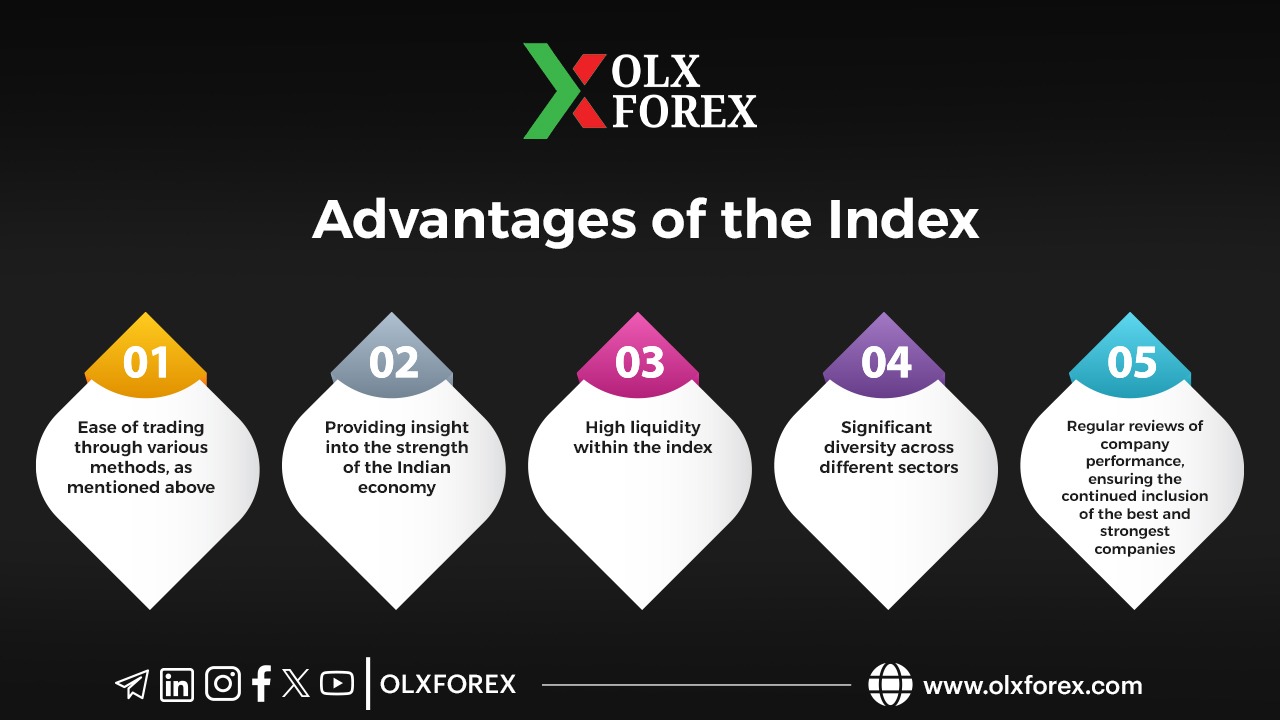
Advantages of the Index
1. Ease of trading through various methods, as mentioned above.
2. Providing insight into the strength of the Indian economy.
3. High liquidity within the index.
4. Significant diversity across different sectors.
5. Regular reviews of company performance, ensuring the continued inclusion of the best and strongest companies.
Disadvantages of Trading the Index
1. The index is easily affected by political and economic news in the country.
2. The influence of some large companies on the index's movement, such as Reliance and HDFC Bank.
3. Some restrictions on foreign investors in certain sectors.
4. Influence from global markets, especially decisions by the US Federal Reserve and oil price crises.
5. A concentration on certain sectors, such as banking and information technology.
Important Tips Before Trading
1. Closely monitor the index's movement and update your technical analysis daily.
2. Follow news related to both India and the United States.
3. Monitor the performance of investment funds specializing in India.
4. Closely follow central bank news, as it has a very strong and direct impact on the index.
5. Exercise caution while trading and ensure you have a robust money management system in place.


