

How Professional Traders Protect Their Capital
Introduction
Many traders believe that success in the markets depends on finding the "perfect trade," but the reality is quite different. Professional traders don't focus on making huge profits on every trade; their primary focus is on protecting their capital. They understand that staying in the market for an extended period allows them to capitalize on strong opportunities, while a single ill-conceived trade can wipe out months of profits. Therefore, the real secret lies not in the number of winning trades, but in the ability to limit losses and manage risk intelligently.
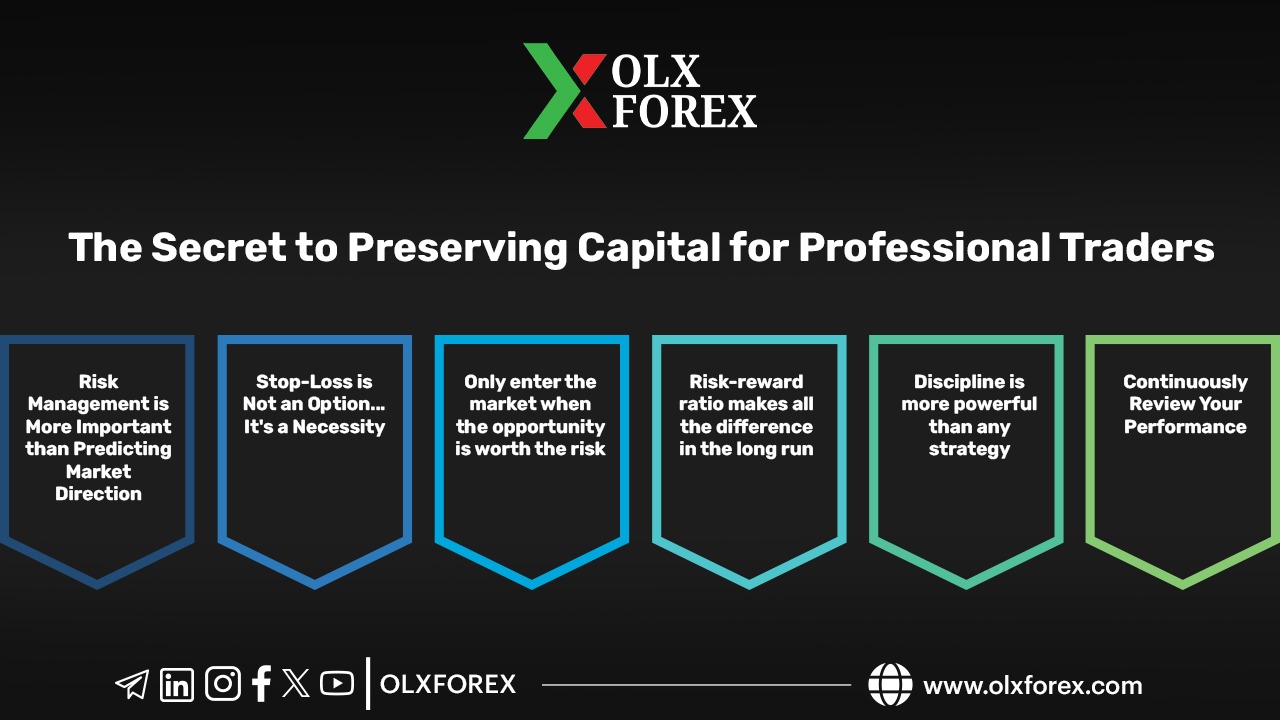
1. Risk Management is More Important Than Predicting Market Direction
Even the best analysts make mistakes in their predictions. Professionals rely not only on accurate forecasting but also on controlling the size of their losses if the analysis is incorrect. This is why many of them commit to not risking more than 1% to 2% of their total capital on any single trade, allowing them to withstand a series of losses without significantly impacting their trading account.
2. Stop-loss is not an option... it's a necessity
Stop-loss orders are among the most important tools for protecting capital. Holding onto a losing trade in the hope that it will turn around can transform a small loss into a large, difficult-to-recover one. Professionals set their stop-loss level before executing a trade and don't extend it based on emotions or the hope of a market reversal.
3. Only enter the market when the opportunity is worth the risk
Not every market movement presents a trading opportunity. Professionals avoid random or boredom-driven trading and wait until their strategy is fully aligned. Reducing the number of ill-considered trades often leads to better results than frequent market entry and exit.
4. The risk-reward ratio makes all the difference in the long run
A trader may not need to win most of their trades to achieve consistent profits. If each trade aims for a profit two to three times the risk, an average success rate may be sufficient for positive long-term results. Therefore, professionals prioritize the risk-reward ratio before considering potential profit.
5. Discipline is More Powerful Than Any Strategy
Anyone can learn a trading strategy, but few can stick to it in all circumstances. A professional trader doesn't chase the market, doesn't double down on positions after a loss, and doesn't let fear or greed dictate their decisions. Discipline is the factor that transforms a plan from mere ideas into tangible results.
6. Continuously Review Your Performance
At the end of each week or month, professionals review all their trades to identify the reasons for success and failure. Keeping a trading log that includes the reason for entry, the reason for exit, market conditions, and mistakes made helps to gradually improve performance and prevents repeating the same errors.
summary
Preserving capital isn't about making quick profits, but about managing risk, adhering to stop-loss orders, carefully selecting trades, maintaining an appropriate risk-reward ratio, disciplined execution of the plan, and continuous performance review. The primary goal of a professional trader isn't maximizing profits, but rather staying in the market with minimal risk so they can capitalize on genuine opportunities when they arise.


