

How Does the Market Anticipate Economic News Before It Is Released?
Introduction
An important economic report may be released, and you might find the currency moving in the expected direction hours or even days before the news is announced. Sometimes, the data is released positively for the currency, but it falls instead of rising.
This is because financial markets don't just trade current figures; they also trade expectations, probabilities, and what might happen in the future. Therefore, investors begin adjusting their positions before the data is released, based on preliminary indicators, central bank statements, and the movements of bonds and other markets.
1. Expectations Move Before Official Data
Before the release of any important economic indicator, analysts formulate their expectations for the anticipated figure, and the markets gradually price in these expectations.
For example, if investors expect inflation data to come in higher than the previous reading, some may start buying the currency before the report is released, because higher inflation could increase the likelihood of interest rates remaining high for a longer period.
Thus, the currency can indeed rise before the data is released.
But there is a crucial point:
The market is more interested in the surprise than the figure itself.
If inflation is expected to reach 3%, and the data comes out at 3%, there might not be a significant market movement because the figure was already anticipated.
However, if the reading comes in at 3.5%, the movement could be larger because the data surprised the market.
Therefore, traders should compare three figures:
Previous reading → Analyst forecast → Actual figure.
The difference between the forecast and the actual figure can be more significant than the actual figure alone.
2. Early Indicators Help Investors Anticipate News
Investors don't wait for the official report to know what's happening in the economy.
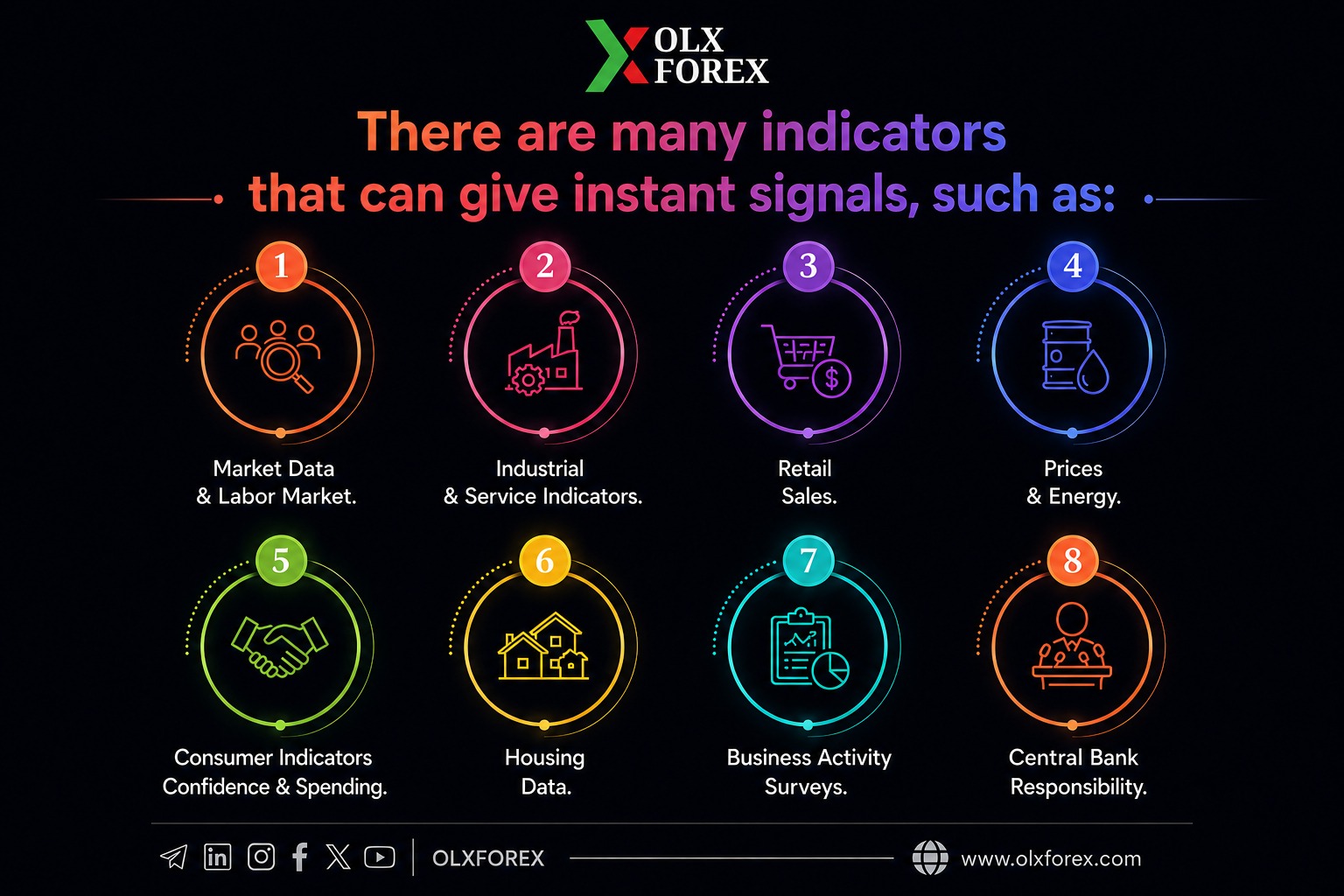
There are a wide range of indicators that can provide early signals, such as:
Preliminary labor market data.
Industrial and services activity indicators.
Retail sales.
Commodity and energy prices.
Consumer and business confidence indicators.
Housing data.
Economic activity surveys.
Statements by central bank officials.
For example, if a set of economic activity indicators begins to show clear weakness, investors might expect the official data to later come in weaker than anticipated.
In this case, the currency might start to decline before the official report is released.
This explains why major investors don't wait for the news itself, but rather try to build a picture of the economy from a wide range of pre-existing data.
However, this doesn't mean that every early indicator will give an accurate prediction; the market can quickly change its expectations if new information emerges.
3. Bond Market and Interest Rates Reveal What Investors Are Pricing
Two of the most powerful tools to monitor for understanding what the market is pricing in are bond yields and interest rate expectations.
If investors begin to believe that the central bank will keep interest rates high for a longer period, bond yields may rise before the release of economic data that could influence this decision.
Consequently, the currency also moves as expectations for monetary policy change.
Example:
If markets expect inflation to fall rapidly, investors may start pricing in a future interest rate cut, which could put downward pressure on the currency.
But if early signs emerge that inflation is rising again, expectations of an interest rate cut may recede, bond yields may rise, and the currency may find support before the official inflation data is released.
Therefore, it's beneficial for traders not only to follow the economic calendar but also to monitor:
Interest rate expectations + Bond yields + The currency itself.
When these markets move ahead of the news release, it provides insight into how investors are repriced future probabilities.
4. Why might the news be positive and the currency fall?
This is one of the most confusing points for traders.
Very strong economic data might be released, yet the currency still declines.
How does this happen?
Because the market might have been expecting a much stronger result.
For example, if the forecast indicated job growth of 200,000, and the actual figure came in at 220,000, the news might seem positive.
However, if the currency had already risen in the preceding days based on expectations of 300,000 jobs, the release of the 220,000 figure might prompt investors to take profits.
Herein lies an important principle:
The market doesn't just ask: Is the news good or bad? It asks: Is the news better or worse than what was already priced in?
This is sometimes called "pre-pricing" the news.
Furthermore, the market's reaction isn't solely based on the data itself. Investors may also consider the details of the report, statements from the central bank, or other data released simultaneously.
Therefore, the initial movement after the news release can be misleading, and the trend may change once the market has absorbed all the details.
Summary
The market anticipates economic news because it doesn't just wait for official data; it tries to predict what the data will reveal and its impact on central bank decisions and the economy.
Prices begin to move based on investor expectations, early economic indicators, statements from central bank officials, changes in bond yields, and interest rate expectations.
Therefore, the best way to interpret the news isn't just to wait for the actual figure, but to compare:
Previous figure + Market expectations + Actual figure + Price reaction.


