
How to Trade During Economic News Events Without Risking Your Account
Introduction
Economic news plays a pivotal role in driving the forex markets. Data such as interest rate decisions, inflation reports, employment figures, and GDP can cause sharp fluctuations in currency prices within seconds.
While some traders see these events as opportunities for quick profits, others suffer significant losses due to poor risk management or hasty decisions.
Therefore, success in trading during news events lies not only in predicting market direction but also in knowing how to manage trades and handle volatility professionally to preserve capital.
1. Understand the Importance of Each Economic News Item
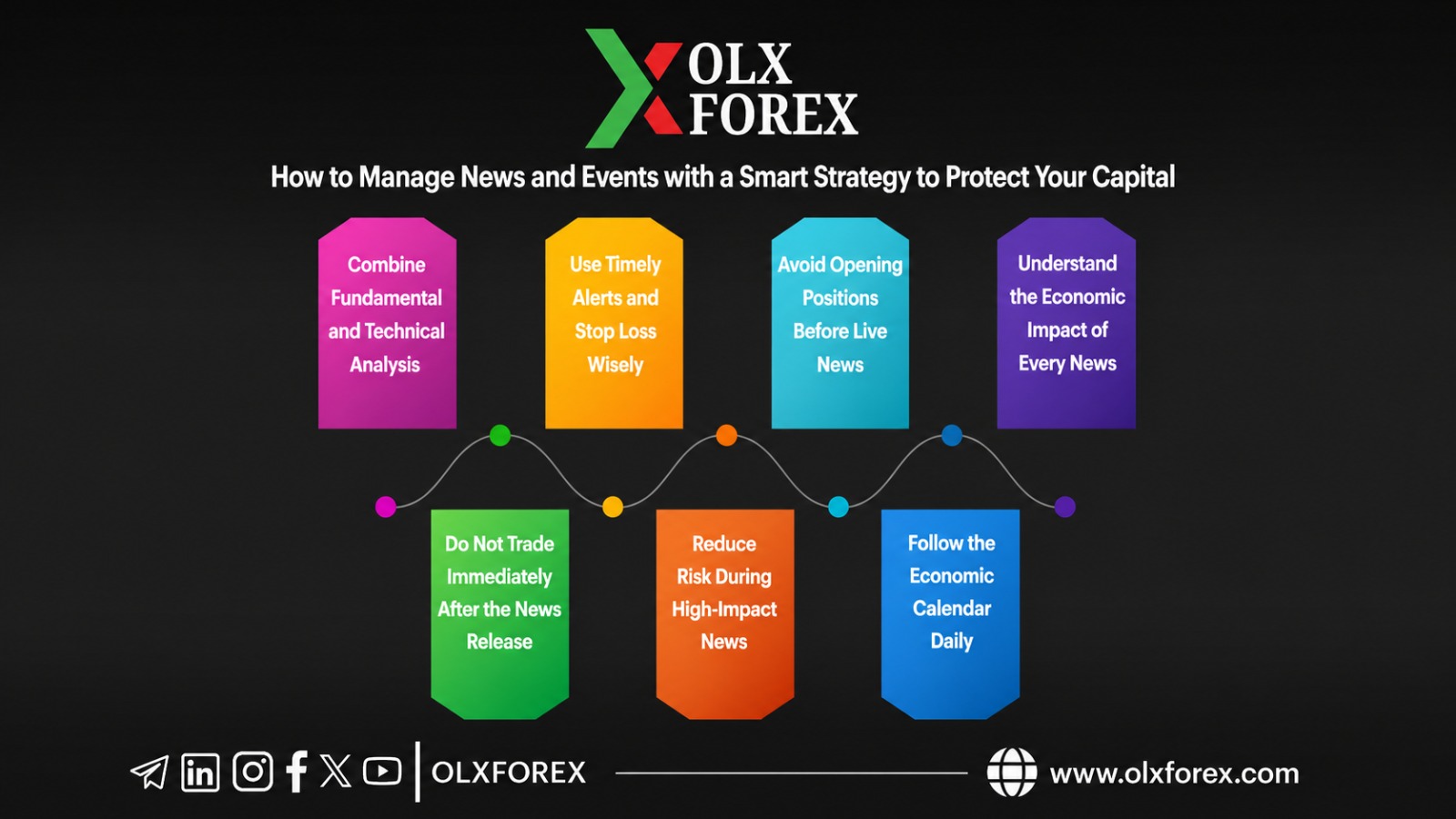
Not all economic news has the same impact on the market. Some cause limited movements, while others lead to violent fluctuations.
Some of the most influential news items include:
Central bank interest rate decisions.
Inflation data (CPI and PPI).
The US jobs report (NFP).
The unemployment rate.
Gross Domestic Product (GDP).
Statements by Central Bank Governors.
The more significant the news, the higher the volatility and risk.
2. Check the Economic Calendar Daily
Before starting your trading session, be sure to check the economic calendar to find out the dates of important news releases and their expected impact on the currencies you trade.
Planning ahead gives you the opportunity to make the right decision, whether to avoid trading or to prepare for potential opportunities after the data release.
3. Avoid opening trades immediately before news releases
Many traders make the mistake of entering trades minutes before news releases, believing they can predict the direction.
But in reality, this can lead to:
A significant widening of spreads.
Price slippage leading to orders being executed at different prices.
Uncontrolled price movements in both directions before the market stabilizes.
This is why many professionals prefer to wait until the market's reaction becomes clear.
4. Reduce your risk during news releases
If you decide to trade during major economic events, it's best to reduce your trade size compared to regular days. High volatility can cause market movements to be larger than expected, so reducing your contract size helps limit potential losses if the price moves against your expectations.
5. Use Stop Loss Orders Wisely
Trade without a stop loss during news releases can be one of the most costly mistakes.
However, you shouldn't place your stop loss too close to your entry price, as natural market fluctuations can trigger it before the market moves in the desired direction.
Be sure to choose a stop loss level that is appropriate for the market's volatility at the time of the news release.
6. Don't Chase the Move After the News Release
Many traders, fearing missing out (FOMO), enter the market after the price has already made a significant move.
This is often the most dangerous stage, as the market may begin to correct or reverse after the initial move.
Waiting for a clear technical signal is often safer than entering too late.
7. Combine Fundamental and Technical Analysis
Economic news alone is not enough to make a trading decision. Technical analysis helps to:
Identify support and resistance levels.
Understand the overall market trend. Choosing the right entry and exit points.
Identifying stop-loss and take-profit levels.
Combining these two analyses gives the trader a more balanced and accurate perspective.
Summary
Economic news is one of the most important drivers of the Forex market, but it is also one of the riskiest periods. Success in dealing with it lies in preparing in advance, following the economic calendar, adhering to sound money management practices, and avoiding emotional decisions or chasing rapid market movements.
Ultimately, protecting capital remains the top priority, as staying in the market for the long term is what gives the trader the opportunity to achieve sustainable profits.


