

Gold Prices Fall Today Ahead of Inflation Data and Interest Rate Hike
Gold prices fell on Monday as the week’s trading began, influenced by strong U.S. jobs data that reinforced expectations of an interest rate hike, while investors await the release of a series of key U.S. inflation data this week, looking for new clues about the Federal Reserve’s expected monetary policy path.
The price of gold fell by about 1% today, hitting a low near $4,385 per ounce, after closing Friday’s session down 1% as well.
U.S. Jobs Data Weighs on Gold Prices
Pressure on gold followed the release of U.S. jobs data on Friday, which showed a strong acceleration in job growth during August, while the unemployment rate held steady at 4.1%.
These results point to a relative improvement in the U.S. labor market following a period of weakness, keeping the possibility of monetary policy tightening and an interest rate hike in September on investors’ radar.
Labor market performance is one of the key factors the Federal Reserve monitors when making decisions regarding interest rates, so any surprise in the jobs data could have a direct impact on the dollar, Treasury yields, and gold prices.
U.S. Inflation Takes Center Stage
Following the release of the jobs report, investors’ focus is now shifting to U.S. inflation data, which could be the decisive factor in determining the direction of interest rate expectations during the Federal Reserve’s upcoming meeting.
The U.S. Producer Price Index (PPI) is scheduled for release on Thursday, with the Consumer Price Index (CPI) data set to be released on Friday.
The Consumer Price Index data is particularly important because it provides a clearer picture of the direction of inflation in the U.S. economy and, as such, may directly influence market expectations regarding the Fed’s upcoming decisions.
The jobs report came in surprisingly better than expected, which put gold under selling pressure, but at the same time, it was not enough to confirm a rate hike in September.
The inflation data expected this week may provide the decisive factor that markets currently lack to form a clearer view of the Fed’s decision.
Higher inflation could reinforce expectations of an interest rate hike and push bond yields higher, which in turn could increase pressure on gold prices.
What are the odds of an interest rate hike in September?
Market expectations for a U.S. interest rate hike have increased following the release of strong jobs data.
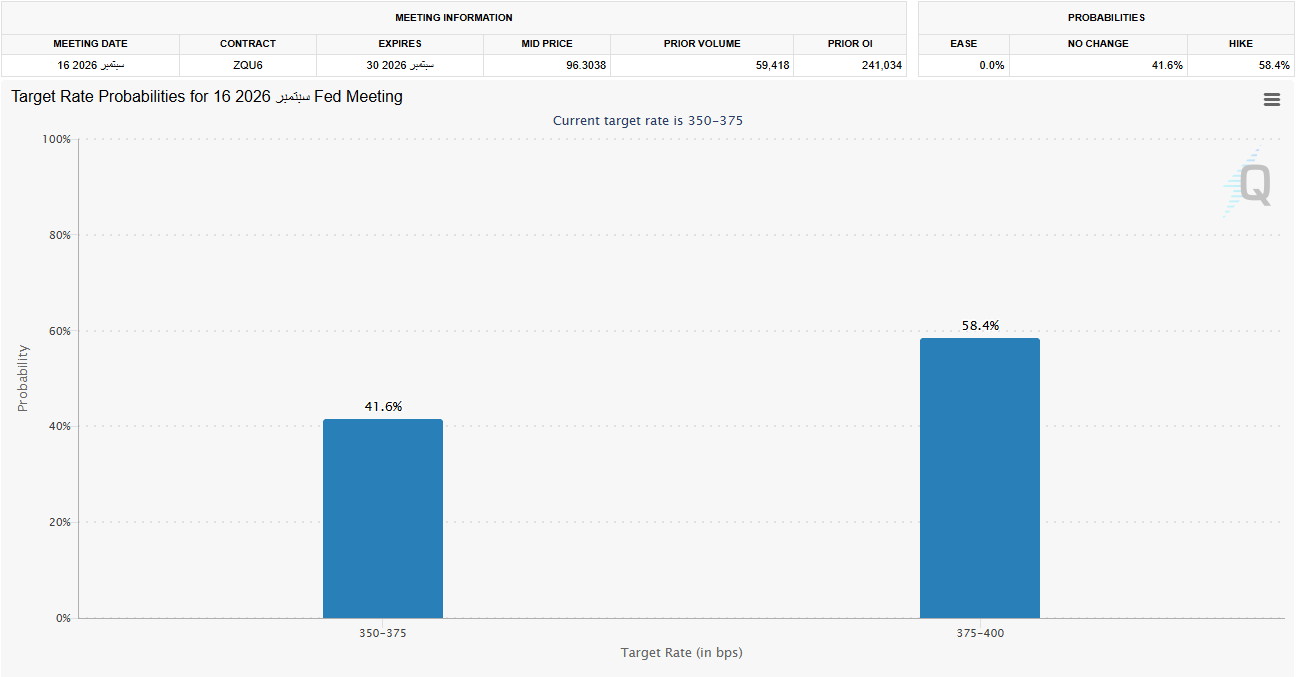
The Chicago Mercantile Exchange’s FedWatch tool shows that traders currently estimate the probability of an interest rate hike at the Federal Reserve meeting scheduled for September 15–16 at approximately 58.4%.
This figure reflects the uncertainty prevailing in the markets, as upcoming economic data—particularly inflation figures—could still shift investors’ expectations ahead of the Fed meeting.
Higher-than-expected inflation data would reinforce bets on continued tight monetary policy, while a weak inflation reading could reduce the likelihood of a rate hike a scenario that might give gold more room to recover.
Why Do Interest Rates Affect Gold?
Although gold is traditionally viewed as one of the most important safe-haven assets and a hedge against inflation and economic risks, rising interest rates typically put pressure on the precious metal.
This is because gold is a non-yielding asset; consequently, the cost of holding it becomes higher compared to assets that benefit from rising interest rates, such as bonds.
Furthermore, rising interest rates may strengthen the U.S. dollar and boost bond yields—two factors that can negatively impact dollar-denominated gold.
Conversely, lower interest rate expectations or falling bond yields could provide support for gold, especially if accompanied by a weaker dollar or heightened economic and geopolitical concerns.
Trump Pushes for Lower Interest Rates
On the U.S. policy front, President Donald Trump stated on Friday that he would cease trade with countries with which the United States has a trade deficit unless the Federal Reserve cuts interest rates.
These remarks come at a time when markets are increasingly sensitive to the future of U.S. monetary policy, especially as the debate over the appropriate interest rate level for the economy continues.
Investors are watching to see whether upcoming economic data will support the Fed’s stance on keeping interest rates high or provide the central bank with more room to ease monetary policy.
Tensions in the Middle East Add Further Uncertainty
In addition to economic factors, geopolitical developments remain a key driver of gold market movements.
In the Middle East, Iran announced its intention to intensify efforts to address the economic fallout from U.S. sanctions, while a high-ranking Iranian official warned of a harsh response should the country face further attacks.
What does the future hold for gold prices in the coming days?
The short-term trend for the price of gold depends largely on the results of the upcoming U.S. inflation data.
If inflation comes in higher than expected
A rise in the Consumer Price Index (CPI) and Producer Price Index (PPI) could heighten expectations of interest rate hikes, which could support the dollar and bond yields and increase pressure on gold.
If inflation data comes in lower than expected
expectations for monetary policy tightening may recede, which could lead to a decline in bond yields and the dollar, thereby giving gold a chance to recoup some of its gains.
At the same time, geopolitical risks may provide support for the precious metal, making gold prices more volatile in the coming days as the Fed meeting in mid-September approaches.


