

Why do most Forex traders fail?
Capital management is the cornerstone of success and avoiding account losses, and many wonder why more than 90% of Forex traders lose their money in the long run.
The truth is that the problem is often not technical analysis or market reading, but rather the lack of capital management in trading.
Many traders chase quick profits while neglecting the rules that protect their accounts from collapse.
Capital management is not just a set of rules, but an integrated system that ensures you stay in the market for as long as possible and gives you a real chance to achieve sustainable profits even if your success rate is only 50%.
What is capital management and why is it the secret to success?
Capital management means determining the amount of risk in each trade, adjusting position size, and managing losses and profits in a systematic and thoughtful manner.
The primary goal is not to make big profits quickly, but to protect your capital and ensure continuity in trading.
The markets are full of opportunities, but without proper risk management, you may lose your account before you can take advantage of them.
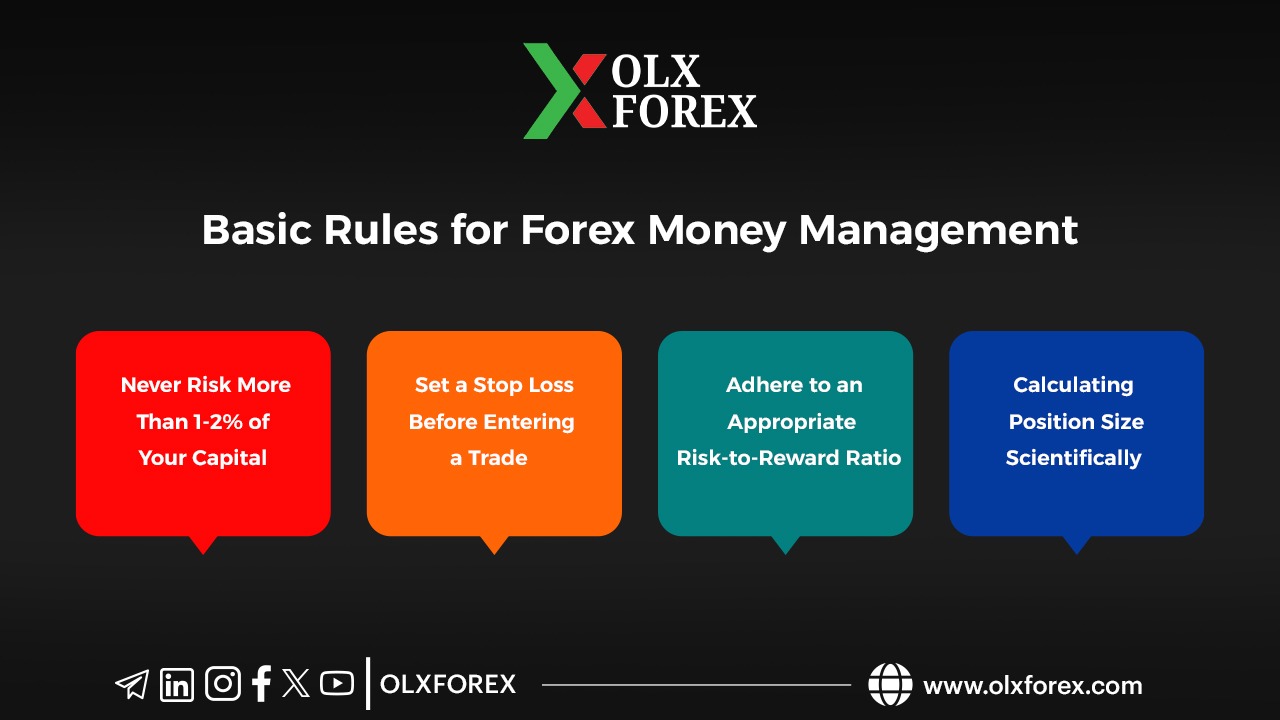
Basic rules for capital management in Forex
1) Do not risk more than 1-2% of your capital
This golden rule of trading states that the risk in any single trade should not exceed 1% to 2% of your total capital.
Example:
If your account balance is $1,000, the maximum loss per trade should not exceed $10-20.
The benefit of this rule is that it protects you from the devastating effect of consecutive losing streaks, which happen even to the best traders.
2) Set a stop loss before entering a trade
Never enter a trade without setting a stop loss in advance.
A stop loss is not an option, but a necessity to protect your account from emotional decisions and sudden market fluctuations.
A professional trader always thinks first about how much they can lose before asking how much they can earn on a trade.
3) Stick to an appropriate risk/reward ratio
Only enter a trade if the potential profit is higher than the expected loss.
The recommended ratio is at least 1:2.
In other words, risk $50 to target a profit of at least $100 or more.
This way, even if you only win half of your trades, you will still be profitable in the long run.
4) Calculate position size scientifically
Instead of opening random trades, you should calculate the lot size based on:
- Account balance
- Specified risk ratio
- Distance between the entry point and the stop loss in points
Illustrative example:
Capital = $1,000
Risk = 1% ($10)
Stop loss = 50 points
Therefore:
Point value = 10 ÷ 50 = $0.2 per point, or 20 cents per point.
5) Use leverage wisely
Leverage can be a powerful tool, but it can be devastating if misused.
Don't use high leverage to compensate for a lack of capital.
Choose a balanced leverage that suits your strategy and experience, and avoid excessive risk that could lead to account liquidation.
How to build your capital management plan?
To become a professional trader, follow these steps:
1) Determine the capital allocated for trading
Do not trade with money you need for your basic expenses.
2) Set a daily and monthly loss limit
For example:
Daily limit: 2%
Monthly limit: 5%
3) Keep your own trading journal
- Record every trade
- Reason for entry
- Risk size
- the result
- your mental state during trading
This will help you to continuously improve your performance.
4) Review your plan regularly
As your account grows, increase your position sizes by the same percentage (1-2%) rather than increasing them randomly.
Discipline is more important than skill
Capital management in Forex is not just about numbers; it is a disciplined trading mindset that distinguishes a successful trader from a gambler.
Start applying these rules today, and you will put yourself on the right path to profitable and sustainable trading.
And always remember that opportunities in the market are endless, but the capital you lose will never return.


