

Why Should You Monitor the Dollar Index Even When Trading Non-Dollar Pairs?
Introduction
Although some forex pairs do not include the US Dollar—such as EUR/GBP or GBP/JPY—the Dollar Index (DXY) remains a crucial tool for understanding market movements. This is because the dollar is a fundamental part of the global financial system; fluctuations in its strength or weakness often influence risk appetite and capital flows between currencies.
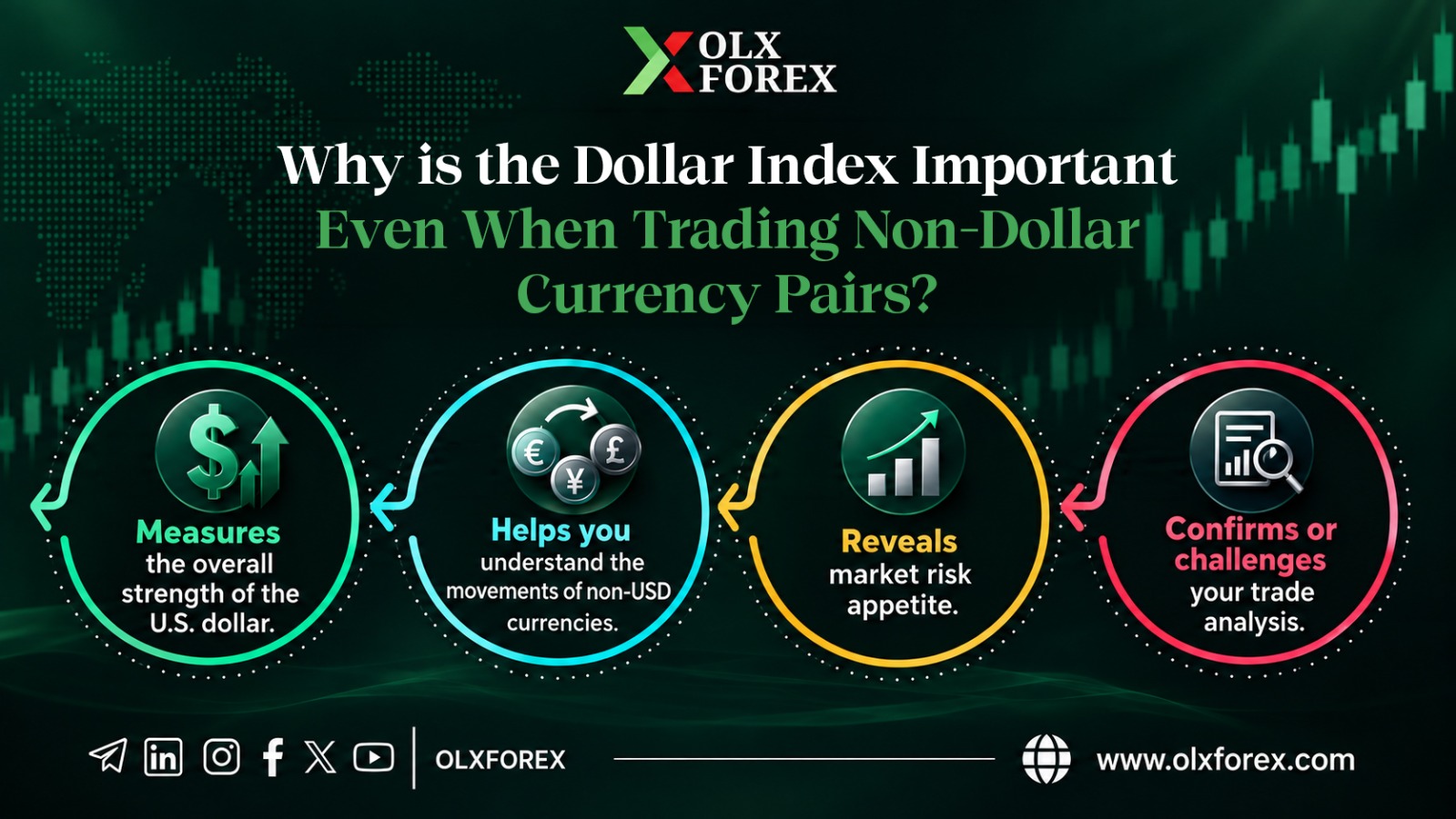
1. Gauging Overall Dollar Strength
The Dollar Index provides a quick snapshot of the dollar's general trend against a basket of major currencies. A strong rise in the DXY may indicate increased demand for the dollar, while a decline could reflect weakness in the US currency. This overview helps traders understand the broader environment in which other currencies are moving.
2. Understanding Movements in Non-Dollar Pairs
Even when trading a pair like EUR/GBP, dollar strength can indirectly impact both the Euro and the British Pound. If the dollar is strongly attracting liquidity, major currencies may face varying pressures, potentially altering the dynamics of cross-currency pairs.
3. Gauging Market Risk Appetite
A rising dollar often coincides with investors shifting toward safer assets, particularly during times of economic or geopolitical uncertainty. Conversely, a weakening dollar may reflect improved risk appetite and increased demand for higher-risk currencies and assets. Thus, the DXY can serve as an additional indicator for gauging market sentiment.
4. Confirming or Challenging Trade Analysis
Monitoring the DXY can help traders confirm their analysis or identify potential inconsistencies. If the analysis points to euro weakness while the Dollar Index is rising sharply, this could reinforce the scenario. However, if the price moves in a direction inconsistent with dollar strength, there may be currency-specific factors that require analysis.
Summary
The Dollar Index is not intended solely for trading dollar pairs; it serves as a general gauge of the US currency's strength and overall market sentiment. Monitoring it alongside technical analysis and economic data helps traders grasp the bigger picture and avoid making decisions based on the movement of a single pair alone.


