
Learn about the importance of risk management
Introduction
In the world of trading, most traders don't lose because of poor analysis or lack of experience, but rather because of something simpler and more dangerous: the size of the risk. A trader might have several successful trades, then a single trade could wipe out a large portion of their capital or even their entire account. This is where the importance of low-risk trading comes in, which professionals consider the first line of defense before even thinking about profits.
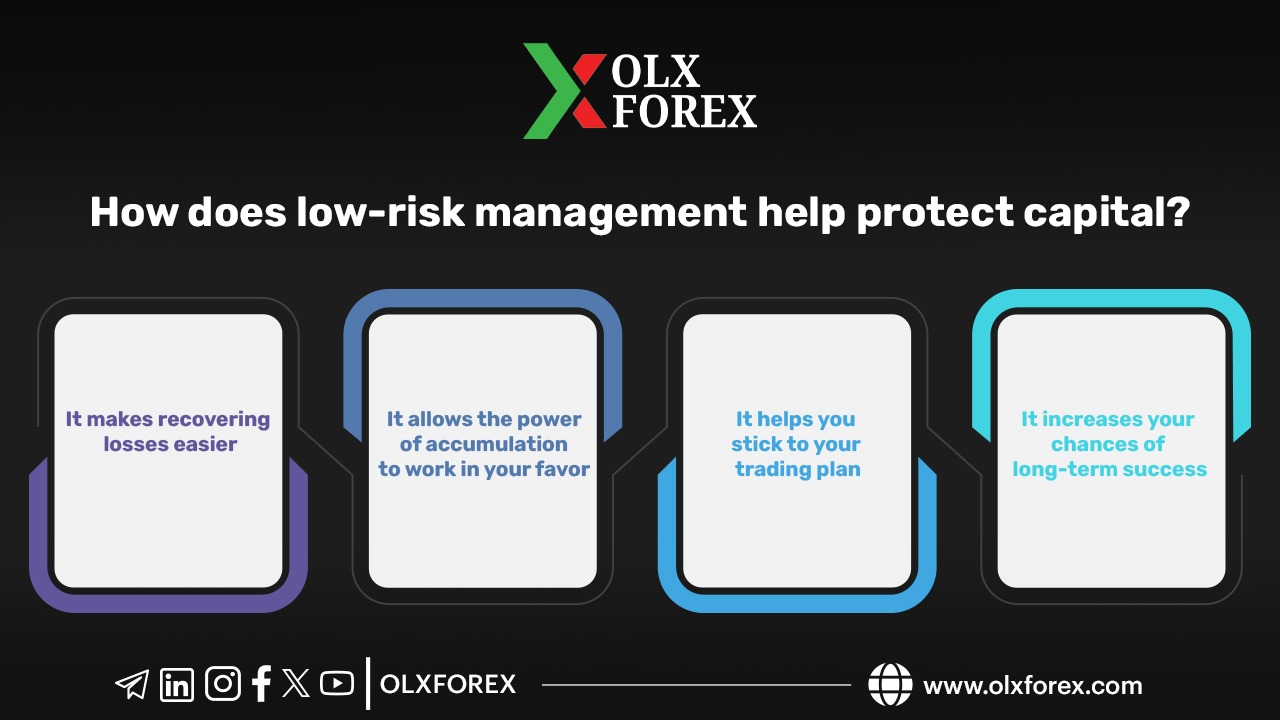
First It makes recovering losses easier
The higher the percentage of loss, the more difficult it becomes to recover.
If a trader loses 50% of their account, they need to achieve 100% profit to get back to square one. However, if the loss is limited by adhering to the 1% rule, recovering the capital becomes much easier.
This is why professionals focus on protecting capital first and then seeking profits second.
Second It allows the power of accumulation to work in your favor
When you maintain your capital and consistently generate profits, the effects of accumulation begin to appear.
As your account grows, the 1% you can risk increases in the future. This way, your profits grow gradually without recklessly increasing your risk.
This approach may seem slow at first, but it's one of the most sustainable ways to build a successful trading account in the long run.
Third It helps you stick to your trading plan.
Risk management isn't just about protecting your capital; it's about discipline.
When you commit to a consistent risk percentage in all trades, you prevent impulsive decisions driven by emotions or a desire to get back at the market after losses.
Over time, trading transforms from an emotional process into a systematic one based on clear and defined rules.
Fourth It increases your chances of long-term success.
Success in trading isn't a sprint; it's a long journey that requires patience and discipline.
A trader who risks 1% on every trade has a greater chance of staying and capitalizing on the best opportunities when they arise in the market. Those who take excessive risks often exit the market before achieving consistent results.
This is why capital management is one of the most important differences between a professional trader and an amateur.
Summary
Risking just 1% on each trade might seem like a conservative strategy to some, but it's actually one of the most powerful tools for survival and success in the financial markets. It protects capital, reduces stress, facilitates recovery from losses, and gives traders the opportunity to benefit from cumulative growth over the long term.
Ultimately, the goal isn't to make huge profits in a single day, but to build a stable trading career that allows you to continue and succeed for years. A successful trader doesn't just think about the next trade; they always think about how to protect their account to seize future opportunities.


