

Learn How Market Makers Use Stop-Loss Hunts
Introduction
One of the most frustrating things for forex traders is that sometimes the price hits the stop-loss order with pinpoint accuracy, then immediately resumes moving in the direction they initially anticipated. This phenomenon is known as "stop hunt," and it's one of the most important concepts any trader should understand before seriously entering the financial markets.
Many beginners believe the market is moving against them personally or that their accounts are being manipulated, but the reality is much deeper. The market moves in search of liquidity and orders concentrated in specific areas, and large institutions always need this liquidity to execute their large trades.
Understanding the concept of stop hunts helps traders read the market professionally and prevents them from falling into the same traps as most traders.
What Does Stop Hunt Mean?
Liquidity hunting is a price movement where the price reaches areas with a large number of stop-loss orders, then reverses and resumes its true market direction.
These areas are often found:
Below clear support
Above clear resistance
At strong highs and lows
Around well-known psychological levels
When most traders place their stop-loss orders in roughly the same location, this area becomes a massive pool of liquidity. Large institutions and banks then begin to push the price towards these areas to execute their orders as efficiently as possible.
Why does the market need liquidity?
Large financial institutions deal in very large volumes of contracts, so they cannot enter or exit the market as easily as the average trader. They need a large number of buy and sell orders to execute their trades smoothly.
Liquidity is like fuel for institutions, enabling them to move within the market. Therefore, they are always looking for areas where traders' orders, especially stop-loss orders, are concentrated.
When these orders are triggered, they become market orders, and this is where institutions obtain the liquidity they need to complete their large trades.
How does a stop-loss hunt actually happen?
Often, traders see strong support levels and buy, then place their stop-loss orders directly below the support. Over time, hundreds or even thousands of orders accumulate in the same area.
Then, the price suddenly moves down and breaks the support quickly, triggering the traders' stop-loss orders. Once this liquidity is gathered, the price sometimes starts to rebound and rise sharply.
At this point, the trader feels like the market "knocked them out" of the trade before the real breakout, when in reality, the market was simply looking for the liquidity below the support.
Why do beginners always fall into this trap?
Beginners often learn analysis using the same traditional methods, so they use very similar places to place their stop-loss orders. This causes their orders to accumulate in obvious and easily targeted areas.
Many also enter a trade as soon as they see a breakout or a quick breakout, without waiting for real confirmation of the move. This makes them vulnerable to false breakouts that occur solely to gather liquidity.
Furthermore, fear and impulsiveness cause traders to close their trades quickly after the stop-loss is triggered, while the real trend may begin immediately afterward.
The Difference Between a True Breakout and a False Breakout
A true breakout occurs when the price successfully breaks through a significant level while momentum and liquidity continue in the same direction. A false breakout, on the other hand, is merely a temporary movement used to collect stop-loss orders before a market reversal.
A false breakout is often characterized by:
A rapid and sudden movement
The price quickly returns to the area
Weak continuation after the breakout
Increased panic among traders
A true breakout, however, is usually more stable and continues after retesting the broken level.
How Do Professionals Handle Stop Hunts?
A professional trader doesn't place stop-loss orders in the usual places everyone sees. Instead, they try to think differently from most traders.
They also don't rush into entering a position as soon as a breakout occurs. Instead, they wait for confirmation of the move and observe price behavior after liquidity has accumulated.
Some professionals sometimes even profit from stop-hunt movements themselves because they know the market can reverse sharply after orders have been collected from clear areas.
True professionalism isn't about avoiding these movements entirely, but about understanding them and dealing with them intelligently.
Is a Stop Hunt Market Manipulation?
Many people describe these movements as manipulation, but the reality is that the market is inherently liquidity-dependent. Institutions need to execute their large orders, and this requires corresponding orders in the market.
Therefore, what's happening isn't a personal attack on small traders, but rather a natural consequence of how financial markets operate.
The problem isn't the existence of Stop Hunts, but rather that most traders place themselves in predictable locations.
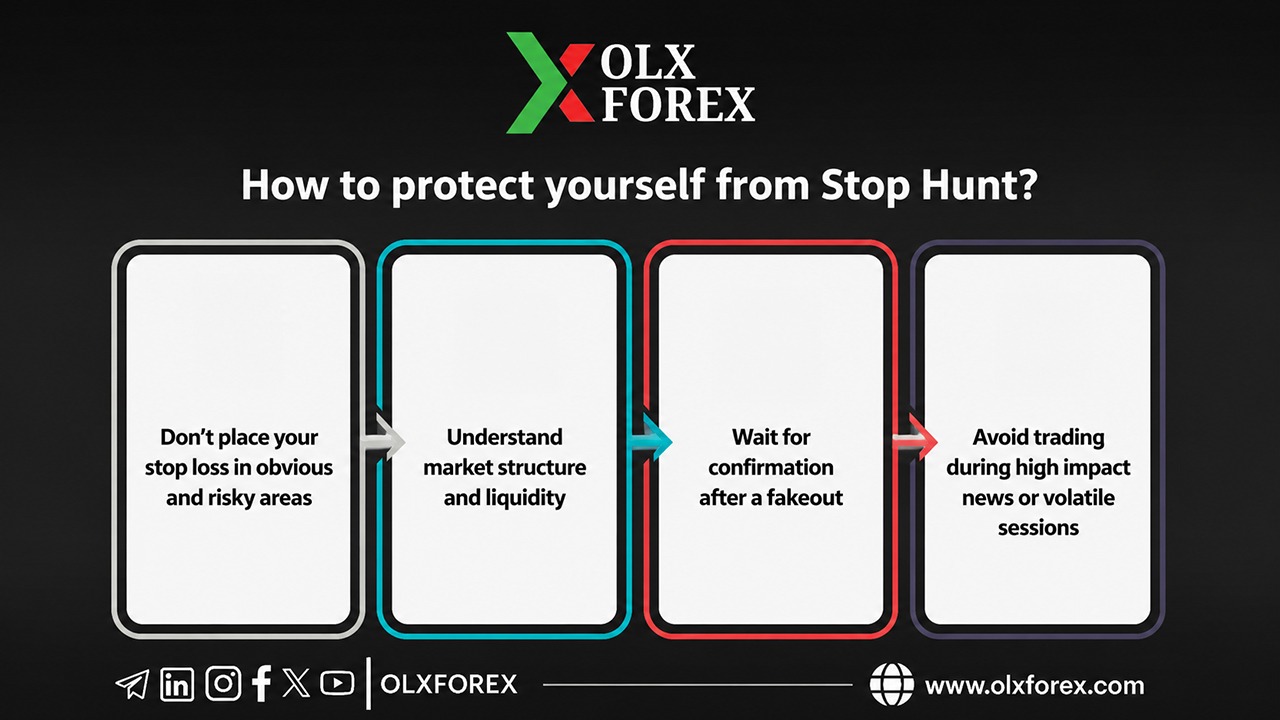
How can you protect yourself from Stop Hunts?
There are several ways to reduce your chances of being caught in these movements, including:
1. Avoid placing your Stop Hunt in very obvious locations.
The more predictable the Stop Hunt location is, the more likely it is to be targeted.
2. Wait for confirmation after a breakout.
Don't enter immediately after a rapid breakout; instead, observe whether the price will continue its upward movement or reverse.
3. Understand Price Action and Liquidity.
Trying to understand where orders accumulate helps you view the market more professionally.
4. Don't enter with a large risk.
Even if you encounter a stop-loss order, good money management can prevent losses from turning into disasters.
Article Summary
A stop-loss order is a natural part of forex market movement. It occurs when the price moves towards areas with a large number of stop-loss orders, creating liquidity for large institutional traders.
The main problem isn't the market itself, but rather that most traders use the same traditional methods.


