

Signs Your Trading Strategy Is Ready for a Live Account
Introduction
Many traders tend to move quickly from a demo account to trading with real money after achieving a few successful trades, believing their strategy is ready. However, the truth is that temporary success doesn't necessarily mean a strategy has a real advantage in the market. Financial markets are constantly changing, and what works in one period may fail in another. Therefore, before risking your capital, you must have practical evidence that your strategy is capable of achieving stable results in the long term.
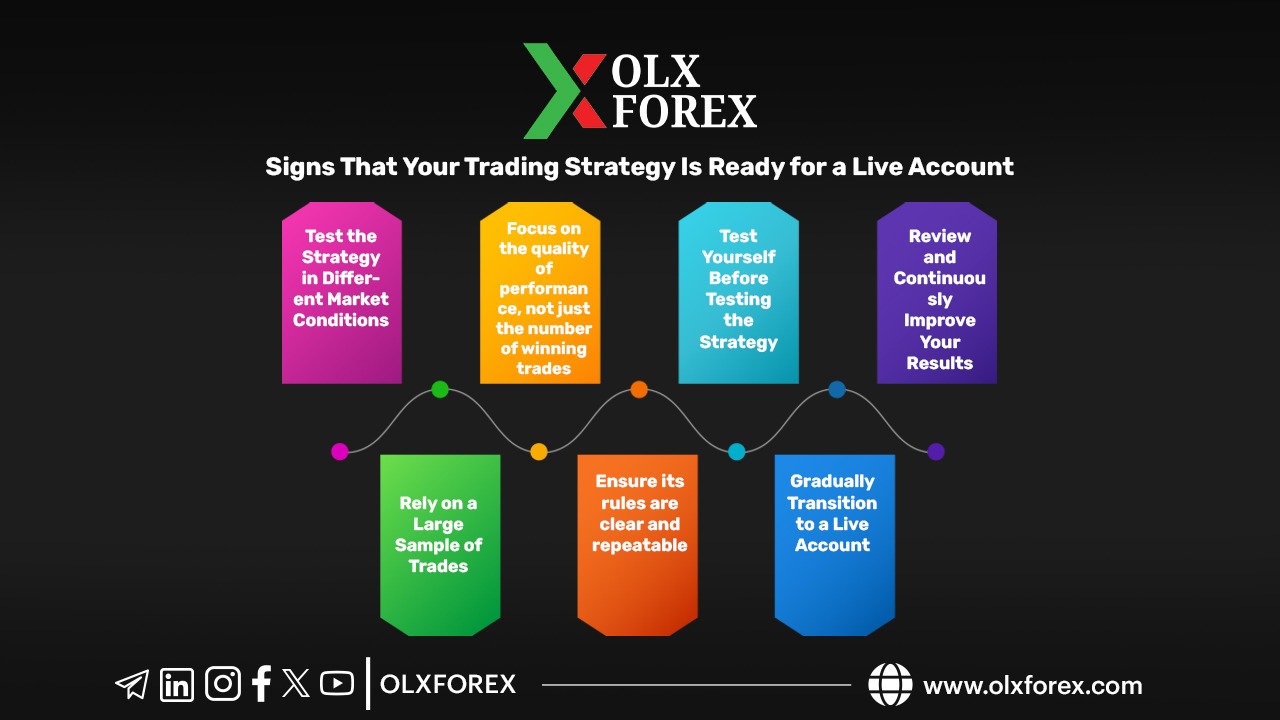
1. Test the Strategy in Different Market Conditions
A good strategy doesn't rely on a single market trend. It must prove its ability to handle rising and falling markets, as well as periods of volatility and sideways movement. If it performs well in only one scenario, it may struggle significantly when market conditions change.
2. Rely on a Large Sample of Trades
No strategy can be evaluated based on a limited number of trades, as short-term results may simply be coincidental. Make sure to test it in at least 100 trades, strictly adhering to its rules. The larger the dataset, the more accurate and realistic the results become.
3. Monitor the quality of performance, not just the number of winning trades
Many traders focus solely on the win percentage, but it's not the most important metric. A strategy might only achieve a 45% success rate, but it's still profitable if the profits from winning trades exceed the losses from losing trades. Therefore, evaluate your strategy based on several indicators, such as:
Consistency of profits over time.
Average profit versus average loss.
Maximum drawdown.
Accessibility of recovery after periods of losses.
4. Ensure its rules are clear and repeatable
If you enter a trade based on "feelings" or personal expectations, you're not following a genuine strategy. All entry, exit, stop-loss, and take-profit rules should be specific and clear, so they can be implemented the same way every time without hesitation or personal interpretation.
5. Test yourself before testing the strategy
The problem might be with the trader, not the strategy. Ask yourself:
Am I following all the rules without exception?
Should I avoid changing my trading plan while trading?
Should I stick to my capital management regardless of the results?
If the answer is "no," you won't be able to properly evaluate your strategy, as the results will be influenced more by behavioral errors than the quality of the system itself.
6. Gradually Transition to a Live Account
Even after successful testing, don't start with large trading volumes. Use the smallest possible contract size initially, as the psychological factor changes completely when risking real money. This stage helps you ensure your ability to adhere to the plan under the pressure of a real market.
7. Review and Continuously Improve Your Results
Markets are constantly changing, so no strategy is perfect forever. Keep a trading log that includes the reasons for entry and exit points and the results of each trade. Then, periodically review the data to identify strengths and weaknesses and make well-considered improvements as needed, without changing the rules after every loss.
Summary
A strategy worth trading with real money isn't one that generates profits in a week or a month, but one that proves successful after sufficient testing and achieves consistent results in various market conditions, while adhering to risk management and discipline. Remember that a trader's success does not depend on having a "magic strategy," but on using a proven system, applying it consistently, and managing capital wisely.


