

Can we rely solely on indicators?
Introduction
A large number of forex traders rely on technical indicators as a primary tool for making buy and sell decisions. With hundreds of indicators available, such as the RSI, MACD, and moving averages, some believe that trading success depends solely on choosing a “magic” indicator that always provides accurate signals. However, the truth is that indicators are merely tools to aid market analysis, not guarantees of profit.
Understanding how indicators work and using them correctly can help traders improve their decisions, but relying solely on them without understanding price action or capital management can lead to repeated losses. Therefore, it is important to know the limitations of indicators, when they are effective, and when they might give misleading signals.
What are Technical Indicators?
Technical indicators are mathematical tools that rely on price and volume data and are used to try to predict future market trends. These indicators translate price action into signals and charts that help traders understand market conditions more clearly.
Some indicators measure trend strength, such as moving averages, while others measure overbought or oversold conditions, such as the RSI. There are indicators that help measure momentum or price volatility. However, all these tools ultimately rely on real-time data, meaning they react to the market more than they predict it.
Why do traders rely on indicators?
Many traders turn to indicators because they make the analysis process easier and faster, especially for beginners. Instead of complexly interpreting price movements, indicators provide direct signals that may seem obvious, such as "buy" or "sell."
Indicators also help reduce emotional distractions during trading because they are based on fixed numerical rules. This gives the trader a sense of confidence and discipline. However, the problem arises when the trader believes that these signals are guaranteed or sufficient on their own to make a decision.
The real problem with relying solely on indicators
The biggest problem with technical indicators is that they rely on past prices, which means their signals are often delayed compared to actual market movement. Often, the price has already moved before the indicator gives an entry or exit signal.
Furthermore, indicators may give false signals during periods of volatility or significant news events. A trader might find themselves entering a trade based on a technical signal while the market is moving sharply in the opposite direction due to economic news or low liquidity.
Relying on a single indicator limits your perspective, as the market is influenced by numerous factors that indicators alone cannot fully explain.
Does having more indicators mean greater accuracy?
Some traders believe that adding a large number of indicators to the chart strengthens the analysis, but in reality, the opposite is often true. Too many indicators can cause confusion and conflicting signals, leaving the trader uncertain about whether to enter a trade or wait.
Some indicators also rely on almost identical formulas, thus producing similar signals but in different forms. Therefore, simplicity in analysis is often more effective than filling the screen with tools and lines.
A professional trader doesn't look for the largest number of indicators, but rather for tools that help them understand the market more clearly.
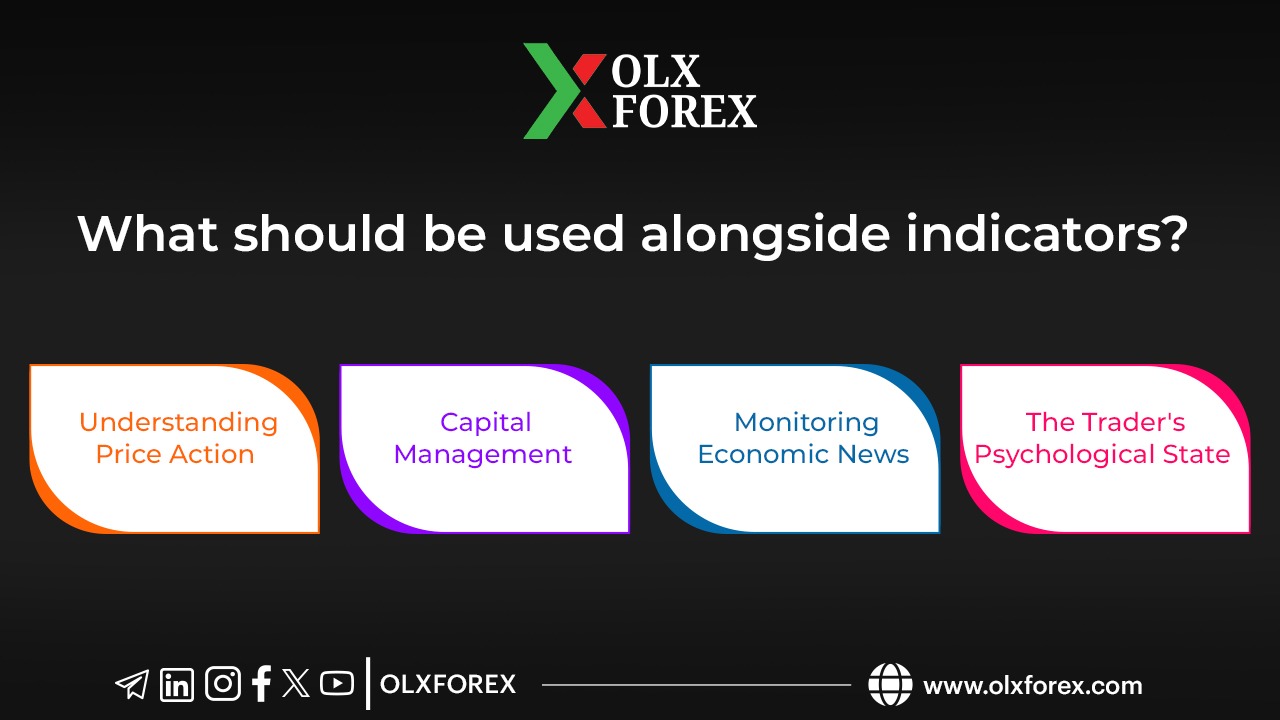
What should be used alongside indicators?
For indicators to be more effective, they must be combined with other important elements of analysis, such as:
1. Understanding Price Action
Reading candlestick patterns and support and resistance levels helps the trader understand the behavior of buyers and sellers directly, something that indicators alone cannot provide with complete accuracy.
2. Capital Management
Even the best indicators do not prevent losses. Therefore, controlling contract size and setting appropriate stop-loss orders are essential for staying in the market.
3. Monitoring Economic News
Indicators might give a strong buy signal, then economic news can completely reverse the trend within minutes. Therefore, it's crucial to monitor important news and not rely solely on technical analysis.
4. The Trader's Psychological State
Fear, greed, and impulsiveness influence decisions more than some realize. A strategy might be excellent, but poor psychological discipline can lead to poor results.
How Do Professionals Use Indicators?
Professional traders don't rely on indicators as their sole source of decision-making. Instead, they use them as an additional confirmation tool. They begin by analyzing the overall trend and price action, then use indicators to determine the strength of the movement or the optimal entry point.
Furthermore, professionals prioritize risk management over the number of trades. They understand that success in Forex isn't about winning every trade, but about achieving consistent long-term profits.
Is it possible to succeed without indicators?
Yes, many traders rely entirely on price action without using any indicators. These traders focus on reading candlesticks, price zones, and direct market behavior.
However, this doesn't mean indicators are useless. It means that a trader's success depends on their understanding of the market and their decision-making process, not on the tool itself.
Summary
Technical indicators are important and useful tools in the world of Forex, but they are not sufficient on their own to guarantee success. Relying solely on them can lead to delayed decisions or false signals, especially in volatile markets.
True success in trading depends on a combination of elements working together, such as understanding price action, managing capital, maintaining psychological discipline, and staying informed about economic news. Indicators should be part of a comprehensive trading plan, not a magic bullet that guarantees profits.
The deeper a trader understands the market, the smarter and more effective their use of indicators becomes.


